
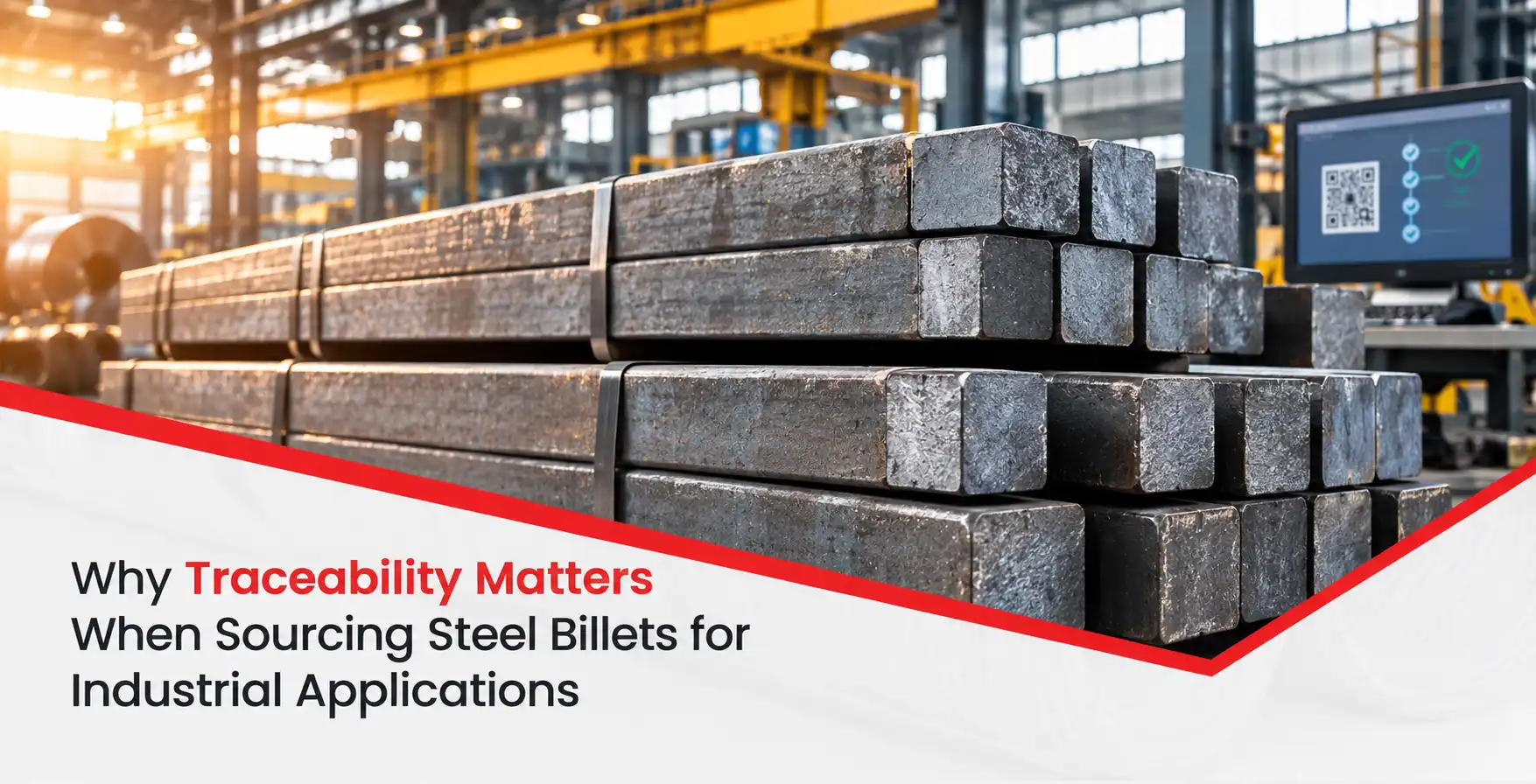
Why Traceability Matters When Sourcing Steel Billets for Industrial Applications
Ask a metallurgist what worries them most about an unfamiliar billet supplier, and it’s rarely the price. It’s the blank space behind the certificate: no record of what happened during melting, no data from the casting run, nothing to check if something goes wrong six months later. For applications where a billet ends up load-bearing or safety-critical, that blank space is the real risk.
What Traceability Actually Covers
A traceable billet isn’t just stamped with a grade and shipped out. Every batch carries a documented path back to its raw material, the melting conditions it went through, how it was cast, and the test results that confirmed it met spec. Miss any link in that chain and you’re left trusting a supplier’s word instead of verifiable data, which works fine right up until it doesn’t.
Steel Billets in Industrial Applications: Why the Stakes Are Higher
Billets roll into TMT bars, wire rods, and structural sections that end up in buildings, bridges, and heavy machinery. A flaw that slips through at the billet stage doesn’t vanish during rolling, it rides along, sometimes staying hidden until the finished product is already installed and under load.
This is what separates industrial applications of steel billets from lower-stakes uses. A hidden defect here isn’t a minor quality slip. It’s a liability that traceability is the only real defence against, since it lets engineers verify the chemistry and process actually match what’s claimed on paper.
Raw Material Source
Sponge iron, scrap, or a particular ore blend, each carries a different impurity profile. A supplier who can show exactly what went into a specific melt gives a buyer something concrete to check against, rather than a generic description that could apply to almost any batch.
Melting and Refining Records
Furnace temperature, refining duration, chemical adjustments made mid-melt, these decide the billet’s final composition more than most buyers realise. Recorded against each heat, this data lets anyone verify the process actually stayed inside spec instead of just assuming it did because the certificate says so.
Casting Conditions
Continuous casting speed, mould temperature, cooling rate: get any of these wrong and porosity or segregation can creep into the billet’s internal structure. Logged per batch, these numbers turn a mystery defect into a traceable one, pointing straight back to the casting run responsible.
Test Results Tied to a Heat Number
Chemical composition and mechanical property checks mean little if they’re only sampled occasionally and assumed to hold across everything else produced that week. A mill test certificate tied to a specific heat number is the difference between traceability and a marketing claim.
What Happens Without Any of This
Say ten billets go into a single rolling run and one of them causes a downstream failure. A supplier without proper batch records can’t tell you which heat caused it or what went wrong during casting. What follows is usually a broader recall than necessary, longer downtime, and a bill that dwarfs what a properly documented failure would have cost. Worse, without records tied to a batch number, there’s no real basis to hold anyone accountable. A verbal assurance isn’t evidence.
How Adukia Industries Handles This
Adukia Industries has produced steel billets since 1971, with output integrated across its group companies and backed by a combined capacity of 1 million MTPA. Billets are made to ASTM, DIN, EN, and BIS standards, and testing gets tracked per batch, not inferred from a general spec sheet.
Because sponge iron production and billet casting sit within the same group, Adukia Industries keeps direct control over that traceability chain instead of depending on outside suppliers at each stage.
Questions Worth Asking Before You Buy
Ask for the mill test certificate tied to the actual heat number involved, not a generic template. Ask whether melting and casting data gets logged per batch. And ask how far back the supplier can trace a problem if one turns up after delivery. Hesitation on any of these questions usually tells you everything you need to know.
FAQs
1. What does traceability mean for steel billet manufacturing?
Every billet is linked back to its raw material, melting process, casting conditions, and batch-specific test results, rather than relying on a general specification.
2. Why does this matter more for industrial applications of steel billets?
These billets often end up in load-bearing or safety-critical roles. A defect that isn't caught early can travel downstream and surface only after the product is already in service.
3. What should a steel billet supplier hand over as proof?
A mill test certificate linked to a specific heat number, covering chemical composition, mechanical properties, and dimensional tolerance for that batch alone.
4. What’s the risk if a billet defect can’t be traced?
Isolating the problem becomes far harder, which usually means broader recalls, longer downtime, and higher costs than a properly documented issue would involve.
5. Are Adukia Industries’ billets traceable?
Yes. They're manufactured to ASTM, DIN, EN, and BIS standards, with batch-level testing and certification tracked through an integrated production process.
Written and Verified by:

Recent Post
Carbon Footprint of Steel: Where Emissions Occur Across the Manufacturing Process
Sun October 2026
Hot Briquetted Iron (HBI) vs Sponge Iron: A Detailed Comparison
Thu October 2026
Why Traceability Matters When Sourcing Steel Billets for Industrial Applications
Mon October 2026
Top Wire Rod Manufacturers in India: Market Leaders to Know in 2026
Fri September 2026
Categories