
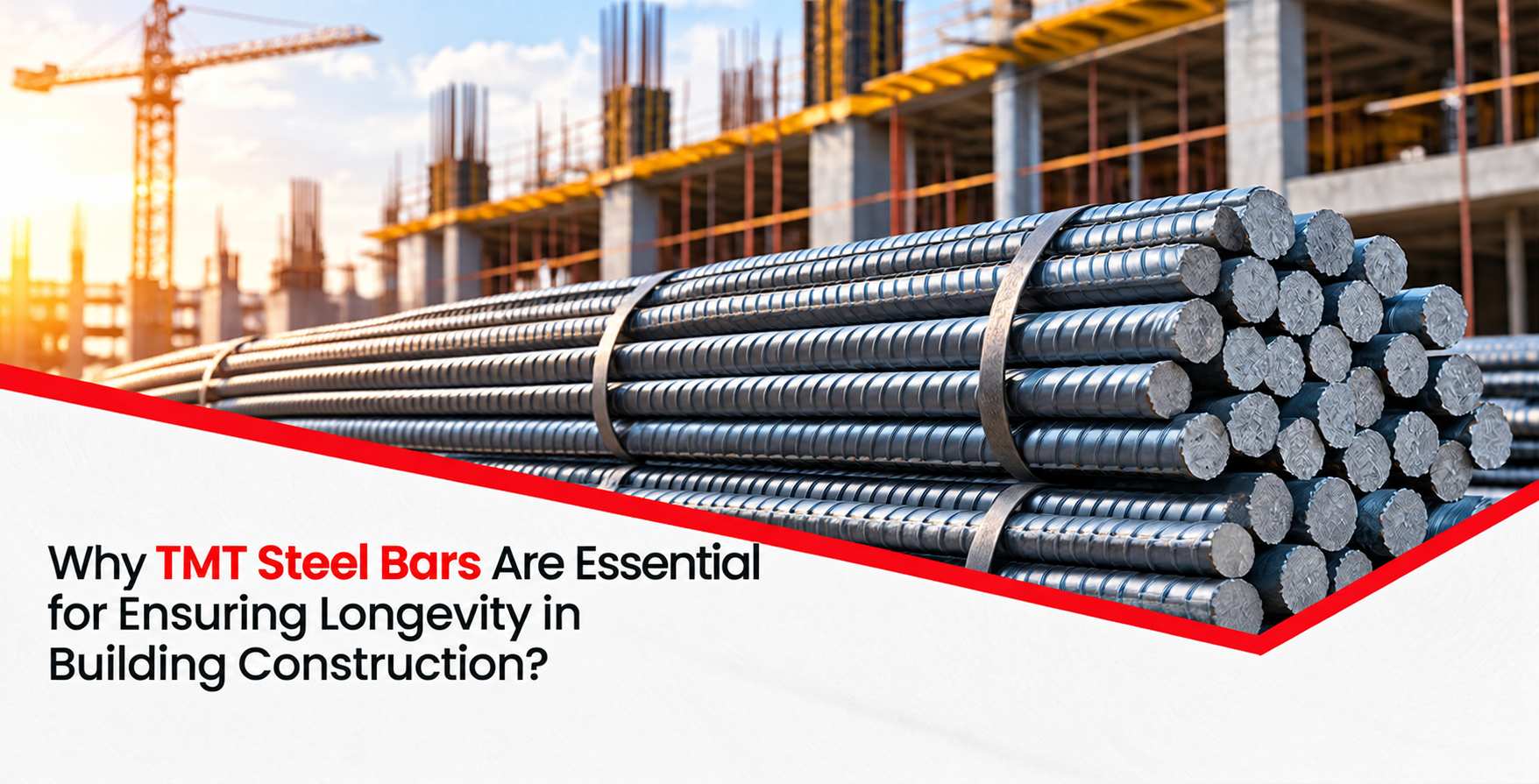
Why TMT Steel Bars Are Essential for Ensuring Longevity in Building Construction?
Longevity is one of the most important factors buyers consider when choosing building materials for construction projects. A material that performs reliably over a longer period can contribute to better strength, durability, ductility, weldability, corrosion resistance and earthquake resistance. Whether the project is a few-storey residential building or a large commercial structure, the quality of reinforcement materials plays an important role in determining the long-term performance of the building.
TMT Steel Bars are essential for long-lasting building constructions because they provide the reinforcement required to improve the strength and stability of concrete structures. Their combination of tensile strength, yield strength and ductility helps structures withstand loads and environmental stresses over time.
In modern construction, steel bars for construction are used to reinforce concrete and improve its ability to handle tensile forces. TMT bars are manufactured through a thermo-mechanical treatment process that creates a hard outer surface and a comparatively softer, ductile core. This combination allows them to provide strength while also accommodating bending and structural movement.
TMT bars are therefore widely used in residential buildings, commercial projects, industrial structures and infrastructure where structural reliability and service life are important considerations.
Are TMT Bars a Superior Choice for Long-Lasting Construction?
TMT bars have changed the way reinforced concrete structures are constructed by combining strength, flexibility and durability in a single reinforcement material. Their distinctive microstructure enables them to withstand substantial stress while retaining the ductility required for structural applications.
The key benefits that contribute to the longevity of TMT bars include:
1. High Strength and Load-Bearing Capability
TMT bars provide high tensile and yield strength, making them suitable for structures exposed to substantial loads and stresses. Their strength helps reinforcement systems support concrete and maintain structural stability during regular use.
The thermo-mechanical treatment process creates a strong outer layer while retaining a ductile inner core. This balance makes a long-life TMT steel bar suitable for applications where both strength and flexibility are required.
2. High Ductility for Structural Resilience
Ductility is an important characteristic when designing structures that may experience sudden or repeated loads. Instead of failing immediately under stress, ductile reinforcement can deform to a certain extent and absorb energy.
This property is particularly important in earthquake-prone areas. TMT bars with appropriate ductility can help reinforced concrete structures respond more effectively to seismic forces and reduce the risk of brittle failure.
3. Better Bonding With Concrete
The bond between reinforcement steel and concrete directly affects the performance of a reinforced concrete structure. TMT bars have a ribbed surface that improves their mechanical grip with concrete and helps transfer loads between the steel reinforcement and surrounding concrete.
Better bonding can reduce slippage and contribute to improved structural stability. This makes the interaction between TMT bars and concrete an important consideration when selecting reinforcement for long-term construction. For more information, see our guide to concrete and TMT bars for strong, durable structures.
4. Corrosion Resistance
Corrosion can gradually weaken reinforcement steel and affect the durability of a concrete structure, particularly in environments exposed to moisture, humidity, rainfall or saline conditions.
TMT bars with appropriate corrosion-resistant properties can help reduce this risk. Adukia Industries’ UltraMax TMT bars are designed with an additional protective layer that helps protect the steel against moisture-related deterioration and supports long-term structural performance.
5. Weldability and Construction Flexibility
Construction projects often require reinforcement bars to be cut, bent and incorporated into different structural configurations. TMT bars with suitable weldability and ductility can make reinforcement work more manageable while supporting different design requirements.
Their flexibility also allows engineers and construction professionals to use them across a range of structural applications without compromising the required strength of the reinforcement system.
6. Resistance to Earthquakes and Environmental Conditions
Buildings are exposed to more than static loads. Wind, earthquakes, temperature variations, moisture and other environmental conditions can affect structural performance over time.
The combination of strength and ductility in TMT reinforcement helps structures respond to these forces more effectively. In seismic regions, ductile reinforcement is especially important because it can absorb and dissipate energy during ground movement. Choosing appropriate earthquake-resistant TMT bars for home construction can therefore be an important consideration for projects in seismic zones.
7. Fire and Heat Resistance
High temperatures can affect the mechanical properties of construction materials. TMT bars are engineered to provide improved performance under elevated temperatures, making thermal resistance another consideration for structural safety.
Using appropriate reinforcement along with proper concrete design and construction practices can help improve the overall resilience of a building.
How High-Quality TMT Bars Support Long-Term Value
The service life of a building depends on several factors, including structural design, construction quality, environmental exposure and the materials selected. TMT bars cannot independently guarantee the lifespan of a building, but high-quality reinforcement can contribute significantly to structural durability when correctly specified and installed.
TMT bars are essential for long-lasting construction because their strength, ductility, concrete bonding, corrosion resistance and flexibility work together to support the reinforced concrete framework.
Choosing the correct grade, size and quality of reinforcement is equally important. Buyers and construction professionals should consider applicable standards, mechanical properties, chemical composition, testing, certification and project-specific requirements before purchasing TMT bars.
For projects where long-term performance is a priority, high-quality TMT bars guarantees durability when the material is correctly selected, designed and installed as part of a properly engineered structural system.
Adukia Industries: Building for Generations
Headquartered in Kolkata, Adukia Industries has decades of experience in the iron and steel industry and supplies TMT reinforcement solutions for construction requirements across India.
Its UltraMax TMT bars are manufactured to deliver a combination of strength, ductility, weldability and durability. The additional protective layer is designed to provide enhanced resistance against environmental exposure, helping reduce the risk of premature deterioration.
Adukia Industries also maintains a broad distribution network to support builders, contractors, dealers and other stakeholders involved in construction. Its focus on product quality, technical performance and customer support makes UltraMax TMT bars suitable for residential, commercial and infrastructure applications.
For construction projects where structural longevity matters, selecting the right reinforcement material is an important first step. TMT bars with the appropriate grade, mechanical properties and corrosion resistance can help create structures designed to remain strong, stable and reliable for years to come.
Frequently Asked Questions
1. Why are TMT bars important for long-lasting buildings?
TMT bars provide reinforcement to concrete and offer a combination of strength, ductility, concrete bonding and resistance to environmental stresses. These properties help improve the structural stability and durability of reinforced concrete buildings.
2. How do TMT bars improve the lifespan of a structure?
TMT bars can contribute to longer structural service life through their strength, ductility, corrosion resistance and strong bonding with concrete. Proper structural design, material quality and construction practices are also essential.
3. Are TMT bars suitable for earthquake-prone areas?
TMT bars with appropriate ductility are commonly used in seismic construction because ductile reinforcement can absorb and dissipate energy during earthquake-related movement. The correct grade should always be selected according to structural design requirements.
4. What should you check before buying TMT bars?
Check the required grade and size, applicable BIS standards, mechanical properties, chemical composition, certification, corrosion resistance and manufacturer quality controls before selecting TMT reinforcement for a project.
Written and Verified by:

Recent Post
Carbon Footprint of Steel: Where Emissions Occur Across the Manufacturing Process
Sun October 2026
Hot Briquetted Iron (HBI) vs Sponge Iron: A Detailed Comparison
Thu October 2026
Why Traceability Matters When Sourcing Steel Billets for Industrial Applications
Mon October 2026
Top Wire Rod Manufacturers in India: Market Leaders to Know in 2026
Fri September 2026
Categories