
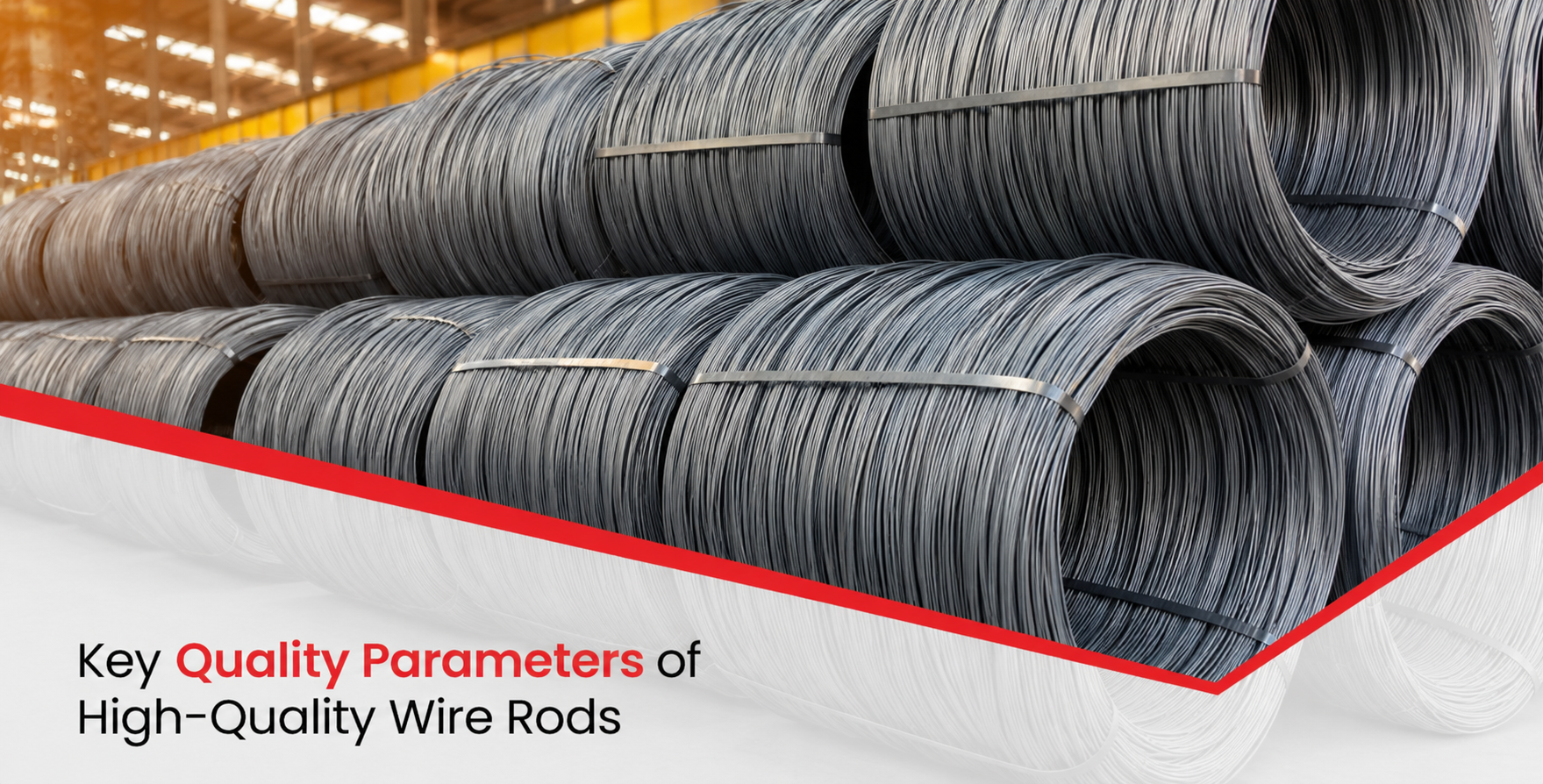
Key Quality Parameters of High-Quality Wire Rods
A wire rod’s quality shows up long after it leaves the mill, usually mid-way through wire drawing, when a batch that looked fine on the coil starts breaking under tension. By then the defect has already cost time, material, and trust in the supplier.
Wire rod feeds into cables, springs, mesh, and fasteners across dozens of industries. Every property it carries, good or bad, passes straight into the wire made from it. That makes the quality checks at purchase worth taking seriously, not treating as a formality.
What Is a Wire Rod?
A wire rod is a semi-finished product with a round cross-section, made by hot rolling billets on continuous rolling mills. Once rolled, it’s wound into coils for handling and transport. It then becomes the raw material for wire drawing operations.
Adukia Industries manufactures wire rods engineered to specific chemistry and mechanical properties for wire drawing mills. The rod’s final performance depends on the process behind it, not just its shape once it’s coiled.
Key Quality Parameters to Check
Chemical composition
Carbon, manganese, sulphur, and phosphorus levels decide how the rod behaves under drawing stress. Small deviations affect ductility and tensile strength more than most buyers expect. A mill test certificate confirms actual composition. A general spec sheet does not.
Mechanical property consistency
Tensile strength and elongation need to hold steady across an entire coil, not just meet a stated minimum in one sample. A rod that varies within the same coil produces unpredictable results on the drawing line. Ask for batch testing data, not a single reference report.
Surface finish
Cracks, scale, or pitting on the rod’s surface rarely improve once the rod is drawn thinner. They tend to get worse. A clean surface lowers breakage risk during drawing and improves how the finished wire looks and performs.
Diameter tolerance
Diameter that drifts along a coil’s length creates problems the moment drawing begins. Confirm the tolerance range the mill actually holds to. Tighter tolerances usually point to better control during rolling.
Roundness of cross-section
A rod’s cross-section should stay round along its full length. Even slight ovality changes how evenly the rod draws down, which matters most where the final wire needs precise dimensions.
Rolling and heat treatment
How the rod is rolled and heat treated shapes its internal grain structure. Continuous rolling mills, properly calibrated, produce more uniform grain than older or poorly maintained lines. Ask what process controls the manufacturer runs, not just what equipment they own.
Coil winding
A poorly wound coil tangles, kinks, or picks up surface damage in transit. Good winding protects the rod until it reaches the drawing mill, which matters as much as the metallurgy behind it.
Manufacturer’s scale and track record
Consistency across large volumes only comes from experience. Adukia Industries has manufactured iron and steel products since 1971, with a combined capacity of 1 million MTPA across its group companies. That scale, combined with continuous rolling capability, is what allows a wire rod to meet the same chemistry and mechanical specification batch after batch.
Reports Worth Requesting
Before an order is finalised, ask for:
- Chemical composition certificate
- Tensile strength and elongation data
- Surface inspection report
- Dimensional tolerance verification
These confirm the rod performs as specified. Nothing more, nothing less.
Choosing a Wire Rod Supplier
A supplier of high quality wire rod should hand over test data without being asked twice, and hold consistent quality across batches, not just on the sample piece shown during sourcing. If a supplier hesitates on documentation, that hesitation is the answer.
Adukia Industries and Wire Rod Manufacturing
Adukia Industries has worked in iron and steel manufacturing for over five decades. Its wire rod is produced by hot rolling billets through continuous rolling mills, built for the wire drawing industry.
The company also manufactures TMT bars, sponge iron, billets, and ERW pipes, under the same production and testing framework. That range across the steel value chain shapes how the company approaches wire rod quality specifically.
FAQs
1. What determines the quality of a wire rod?
Chemical composition, tensile strength, surface finish, and diameter consistency together decide how well a rod performs during wire drawing.
2. Why does surface finish matter this much?
Surface defects worsen once the rod is drawn into thinner wire. A clean surface reduces breakage and improves the finished wire’s performance.
3. What documents should a wire rod supplier provide?
Mill test certificates covering chemical composition, tensile strength, and dimensional tolerance. These confirm the rod meets the stated specification.
4. What wire rods does Adukia Industries manufacture?
Adukia Industries produces wire rods engineered to specific chemistry and mechanical properties, built for wire drawing mills in international markets.
5. How does the rolling process affect wire rod quality?
Continuous rolling mills, when properly calibrated, create more uniform grain structure, which directly improves consistency in the finished rod’s mechanical properties.

Recent Post
Hot Briquetted Iron (HBI) vs Sponge Iron: A Detailed Comparison
Thu October 2026
Why Traceability Matters When Sourcing Steel Billets for Industrial Applications
Mon October 2026
Top Wire Rod Manufacturers in India: Market Leaders to Know in 2026
Fri September 2026
What to Check When Buying ERW Steel Pipes for Industrial Use
Tue September 2026
Categories