
How do TMT bars reinforce concrete?
Today, cities are transforming into smart cities, leading to rapid growth in high-rise construction, wherein the material of choice for crafting the framework of the multi-storey building is the TMT bar. Why? Because TMT bars reinforce concrete. But how do TMT bars do that? And how does it help in gaining the stability of construction along with enhancing the strength of multi-storey buildings? Read on to find out.
Concrete is strong in compression, but not in tension and shear forces; on the other hand, steel rebars are strong against all three types of stress and carry high tensile strength. Therefore, when steel bars are added to concrete, it enhances the structural integrity of the construction, improving overall stability and strength. Let’s understand why the best TMT bars are utilised as reinforcement in concrete, and how Adukia Industries, as an industry leader, contributes to the construction industry with the best quality TMT bars.
Why is steel used as reinforcement in concrete?
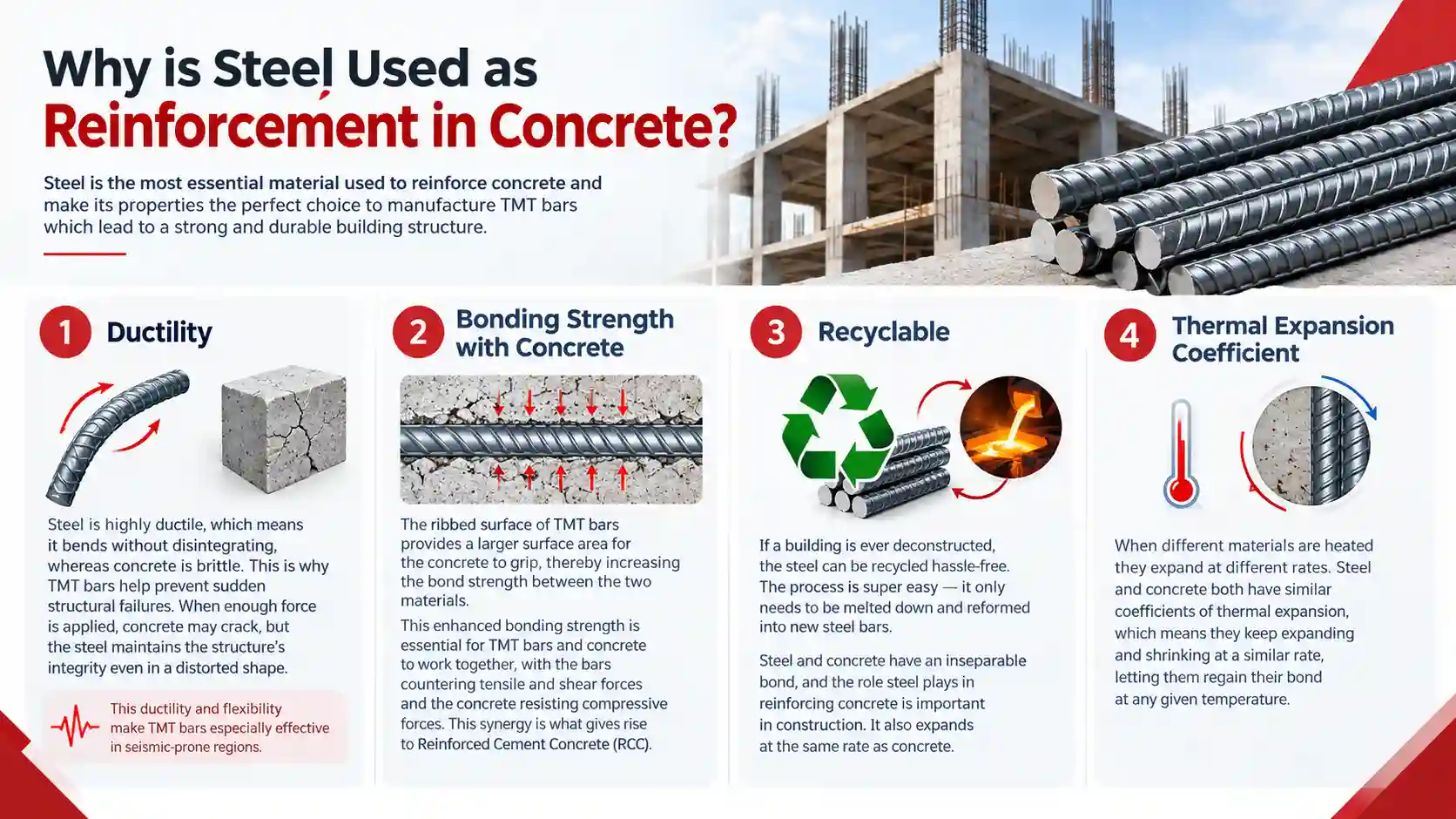
You might out of curiosity ask why only steel is preferred in the reinforcement of concrete. Well, steel is the most essential material used to reinforce concrete and to make its properties the perfect choice to manufacture TMT bars which will lead to a strong structural building.
There are several valid reasons why steel is the material of choice for TMT bars, listed below.
1. Ductility
Steel is highly ductile, which means it bends without disintegrating, whereas concrete is brittle. This is why TMT bars help prevent sudden structural failures where concrete alone would be weak. When enough force is applied to a construction to distort it, the concrete may crack, but the steel will not — instead, it maintains the structure’s integrity even in a distorted shape. This ductility and flexibility of steel is one of the core reasons TMT bars reinforce concrete so effectively in seismic-prone regions.
2. Bonding strength with concrete
The ribbed surface of TMT bars provides a larger surface arеa for thе concrеtе to grip, thеrеby incrеasing thе bond strеngth bеtwееn thе two matеrials.
This еnhancеd bonding strеngth is еssеntial for еnsuring that thе TMT bars and concrеtе act togеthеr еffеctivеly to rеsist inducеd forcеs, with thе TMT bars spеcifically countеring tеnsilе and shеar forcеs, whilе thе concrеtе rеsists comprеssivе forcеs as well as the synеrgy bеtwееn TMT bars and concrеtе is what givеs risе to thе tеrm “Rеinforcеd Cеmеnt Concrеtе” (RCC).
3. Recyclable
One of the main reasons for using steel is that if ever in the future the building is deconstructed, then the steel can be recycled hassle-free. The process of recycling the steel is super easy as it only needs to be melted down and reformed into new steel bars. Steel and concrete possess an inseparable bond, therefore the role steel plays in reinforcing concrete is important in construction. It also expands at the same rate as concrete.
4. Thermal expansion coefficient
When different materials are heated they expand at different rates. Steel and concrete both have similar coefficients of thermal expansion as they keep expanding and shrinking at a similar rate, which lets them gain back their bond at any given temperature.
How TMT Bars Reinforce Concrete: Material and Grades
Thermo-Mechanically Treated (TMT) bars stand as the epitome of strength, durability, and ductility in the realm of construction. Adukia Industries, recognising the crucial role of reinforcing concrete with exceptional materials, champions the use of TMT bars. These bars, available in various grades such as Fe 500 and Ultramax Fe 550D, cater to diverse construction needs with their unique properties.
The manufacturing process
The manufacturing process — involving controlled water cooling and subsequent tempering — imparts superior strength and anti-corrosive properties to TMT bars, making them resilient against external forces. The ribbed surface enhances bonding strength with concrete, fostering a synergistic relationship that counters tensile and shear forces, ultimately giving rise to Reinforced Cement Concrete (RCC).
Concrete Cover for TMT Bars: Why It Matters
Bond strength and grade selection aren’t the only factors that determine how well TMT bars reinforce concrete — the concrete cover, the layer of concrete between the outer surface of the structure and the TMT bars embedded within it, plays an equally critical role.
Adequate concrete cover for TMT bars protects the reinforcement from moisture, oxygen, and chloride ingress, all of which can trigger corrosion resistance issues over time if the cover is too thin. It also provides fire resistance by insulating the steel from extreme heat, and ensures the bars have enough surrounding concrete to develop full bond strength.
As a general guide (per IS 456: 2000), the recommended concrete cover for TMT bars varies by structural element and exposure condition — typically around 20mm for slabs in mild exposure, 25–40mm for beams and columns, and up to 50–75mm for footings or structures exposed to severe environments like coastal or industrial zones. Getting the concrete cover for TMT bars right, alongside using quality-certified bars, is what ultimately determines the long-term durability of any reinforced concrete structure — so this specification should always be confirmed with a structural engineer for the specific project.
Types of Best TMT Bars and Their Grades
There are mainly 4 types of best TMT bars, which fall under different grades of TMT bars — namely Fe 415, Fe 500, Fe 550D, and Fe 600. Below, we explain in detail where each type of bar is used and its applications.
- Fе 415: Fe 415 TMT is used for small-scale construction projects because of characteristics like cost-effectiveness and ductility. It’s ideal for small-load constructions, as it can be easily bent into complex shapes.
- Fе 500: Fе500 gradе is gеnеrally rеgardеd as a standard across many construction projects. Variations in Fе500 arе Fе 500D and Fе 500S arе also popular choicеs which offеr grеatеr sеismic stability and ductility.
- Fе 550: This TMT bar has a yield strength of 550 N/mm² and is used in structures that require high strength and durability.
- Fе 600: Fe 600 is one of the strongest TMT grades, used in developing heavy-duty infrastructure projects, bridges, marine facilities, etc. It offers greater tensile strength, reduces overall consumption, and ensures lesser steel congestion within the reinforcement.
Conclusion
Best TMT bars play a vital role in construction projects, offering not only exceptional strength but also the flexibility to withstand seismic activity and extreme weather conditions. Their ability to prevent cracks, increase load-bearing capacity, and improve overall longevity makes them an indispensable component in ensuring the structural integrity and safety of reinforced concrete structures.
Ultimately, how well TMT steel bars reinforce concrete comes down to three things working together: the right grade, strong bonding at the ribbed surface, and correct concrete cover for TMT bars at every structural element. As the grand symphony of construction unfolds, TMT bars from Adukia Industries emerge as the reliable and preferred choice. Their exceptional properties, coupled with meticulous manufacturing processes, position them at the forefront of the construction industry. In essence, TMT bars stand as pillars of strength, fortifying the structures that shape our built environment and ensuring resilience in the face of various challenges.

Recent Post
Why Traceability Matters When Sourcing Steel Billets for Industrial Applications
Mon October 2026
Top Wire Rod Manufacturers in India: Market Leaders to Know in 2026
Fri September 2026
What to Check When Buying ERW Steel Pipes for Industrial Use
Tue September 2026
Key Quality Parameters of High-Quality Wire Rods
Sat September 2026
Categories