
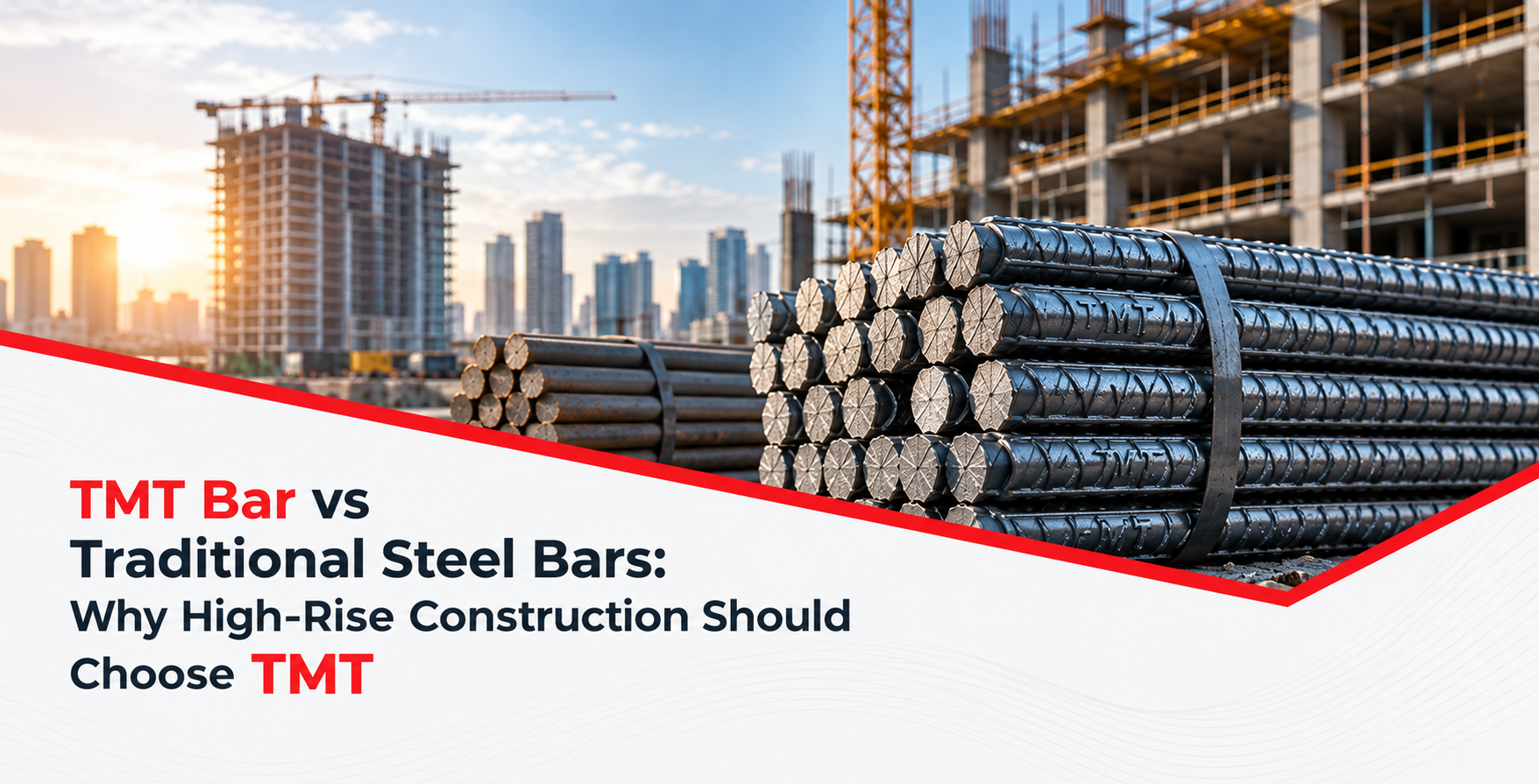
TMT Bar vs Traditional Steel Bars: Why High-Rise Construction Should Choose TMT
If you are thinking of using TMT bars instead of traditional bars, it is worth understanding what you gain. Traditional bars are not as advanced as TMT bars and may not give you the performance that high-rise structures demand. Before we decide what to choose, let us compare how TMT bars and traditional steel bars differ in manufacturing, strength and long-term value.
TMT bars undergo a heat treatment process, followed by quick cooling and stretching, for boosted strength and ductility (see our guide to the TMT bar manufacturing process). Traditional steel bars, on the other hand, are cold-twisted at room temperature. TMT bars have a soft ferrite-pearlite core with a hard martensitic outer surface, giving high surface hardness, while traditional steel bars show variations along their length. TMT bars also excel in corrosion resistance, unlike traditional bars, which are susceptible to rust. TMT bars may have a higher upfront cost, but their long-term benefits make them a worthwhile investment, whereas traditional steel bars are cost-effective at the start and depend on the type and grade.
Construction Steel Comparison: Difference Between TMT Bars Vs Traditional Bars
Here is a quick look at TMT Bars Vs Traditional Bars in India across the parameters that matter on site.
| Parameter | TMT Bars | Traditional Steel Bars |
|---|---|---|
| Manufacturing | Heat treatment, quenching and stretching | Cold twisting at room temperature |
| Structure | Soft ferrite-pearlite core, hard martensitic surface | Uniform, with variations along the length |
| Strength | Fe 500D TMT bars start at 500 MPa yield strength | Plain mild steel bars are around 250 MPa |
| Ductility | High; suited to seismic zones | Lower; more prone to brittle failure |
| Corrosion resistance | Better, with a longer service life | Susceptible to rust |
| Weldability and bending | Easy, without losing strength | Limited flexibility |
| Consistency | Uniform strength along the full length | Can vary |
| Cost | Higher upfront, lower lifecycle cost | Lower upfront, higher maintenance |
TMT Steel Benefits: Why Use TMT Bars Over Traditional Steel Bars?
The TMT steel benefits below cover durability, ductility, bendability, weldability, corrosion resistance, cost-efficiency, environmental sustainability and quality standards. Each point is part of a practical comparison that explains why TMT bars are preferred over traditional steel bars in construction across India.
1. Strength and Durability of TMT Bars
When we talk about high-rise construction, durability and strength are non-negotiable. TMT bars, made through the thermo-mechanical process, show superior strength compared with traditional steel bars. The process applies intense heat treatment followed by quenching, which creates a fine-grained microstructure and boosts tensile strength. Higher grades such as Fe 500D and Fe 550D are explained in our guide to TMT steel bar grades and applications. This combination of strength and durability means TMT bars from Adukia Industries can handle the heavy stress and loads of high-rise construction, where even the 8mm TMT bar plays a structural role.
2. Enhanced Ductility for Earthquake-Prone Zones
Ductility is the ability of a TMT bar to elongate without losing its strength. It determines how much a bar can bend to meet construction requirements, which makes it especially important in earthquake-prone zones. Traditional steel bars are less able to absorb such forces, which makes TMT bars more flexible and reliable. During seismic events, TMT bars resist brittle failure and cracking. These characteristics are vital for occupant safety and for keeping the building intact; read more on earthquake-resistant homes built with TMT bars.
3. Bendability and Weldability
High-rise buildings demand versatility and customization in structures. TMT bars are weldable and bendable, which allows easy shaping as per project specifications. The reason to choose TMT bars is their ability to bend without compromising strength in complex structures. They give designers flexibility without weakening structural solidity. We always suggest clients choose TMT bars because they offer more than traditional bars, which limit what a design can achieve.
4. Corrosion Resistance
Another important property of TMT bars in high-rise construction is corrosion resistance. The TMT bar is built to face challenges such as pollutants and moisture, which accelerate corrosion in traditional steel bars. Adukia Industries’ TMT bars are made to resist rust, which gives the building a longer lifespan and reduces maintenance cost over time. For coastal or humid sites, explore corrosion-resistant TMT bars.
5. Cost-Efficiency
While the upfront cost of TMT bars may be a little higher than that of traditional bars, the long-term benefit outweighs the initial investment. Higher durability and lower maintenance needs deliver significant savings over the life of the building. At Adukia Industries, we understand the importance of cost-efficiency and focus on products with lasting value. Understand how steel bar pricing impacts construction before you budget.
6. Environmental Sustainability
The environmental sustainability of TMT (Thermo-Mechanically Treated) bars and traditional steel bars can be evaluated on recyclability, resource utilisation and production process. Here is how the two compare (more in our guide to building green with TMT bars).
7. Quality Standards and Assurance
Quality standards and assurance are important when comparing traditional and TMT bars. The two types differ in production methods, which affects how closely they meet industry standards. TMT bars made by an ISI-certified manufacturer follow IS 1786.
TMT Bars Vs Traditional Bars in India: Which Is Better for House Construction?
For house construction too, traditional bars will not meet the expectations that TMT bars do. TMT bars help your building stay strong under heavy loads, and their strong structure helps withstand earthquakes. They resist corrosion, which adds to the life of the bars and your house. Last but not least, TMT bars offer peace of mind: you are less likely to face damage caused by time and environmental factors. See our pick of the best TMT bar for house construction.
Frequently Asked Questions
1. What is the difference between TMT Bars Vs Traditional Bars?
TMT bars are heat-treated, quenched and stretched, giving a hard outer surface and a soft, ductile core. Traditional bars are cold-twisted, so their properties can vary along the length. As a result, TMT bars offer higher strength, better earthquake performance and stronger corrosion resistance.
2. Are TMT bars better than traditional steel bars for high-rise buildings?
Yes. High-rise buildings carry heavy loads and face seismic and weather stress. TMT bars give higher strength, ductility and corrosion resistance, which supports safety and a longer building life.
3. What are traditional steel bars?
In Indian construction, traditional bars usually mean mild steel and cold-twisted deformed (CTD/TOR) bars. Compare them in detail in our posts on TMT bars vs CTD bars and TMT bar vs TOR steel.
4. What are the main TMT steel benefits?
High tensile strength, ductility, weldability, corrosion resistance, consistent quality and lower lifecycle cost.
5. Are TMT bars more expensive?
They usually cost more upfront, but lower maintenance and a longer service life make them more economical over time.
6. Which standard do TMT bars follow in India?
TMT bars follow IS 1786, with grades such as Fe 500, Fe 500D, Fe 550D and Fe 600.
1. What is the difference between TMT Bars Vs Traditional Bars?
TMT bars are heat-treated, quenched and stretched, giving a hard outer surface and a soft, ductile core. Traditional bars are cold-twisted, so their properties can vary along the length. As a result, TMT bars offer higher strength, better earthquake performance and stronger corrosion resistance.
2. Are TMT bars better than traditional steel bars for high-rise buildings?
Yes. High-rise buildings carry heavy loads and face seismic and weather stress. TMT bars give higher strength, ductility and corrosion resistance, which supports safety and a longer building life.
3. What are traditional steel bars?
In Indian construction, traditional bars usually mean mild steel and cold-twisted deformed (CTD/TOR) bars. Compare them in detail in our posts on TMT bars vs CTD bars and TMT bar vs TOR steel.
4. What are the main TMT steel benefits?
High tensile strength, ductility, weldability, corrosion resistance, consistent quality and lower lifecycle cost.
5. Are TMT bars more expensive?
They usually cost more upfront, but lower maintenance and a longer service life make them more economical over time.
6. Which standard do TMT bars follow in India?
TMT bars follow IS 1786, with grades such as Fe 500, Fe 500D, Fe 550D and Fe 600.

Recent Post
Why Traceability Matters When Sourcing Steel Billets for Industrial Applications
Mon October 2026
Top Wire Rod Manufacturers in India: Market Leaders to Know in 2026
Fri September 2026
What to Check When Buying ERW Steel Pipes for Industrial Use
Tue September 2026
Key Quality Parameters of High-Quality Wire Rods
Sat September 2026
Categories