
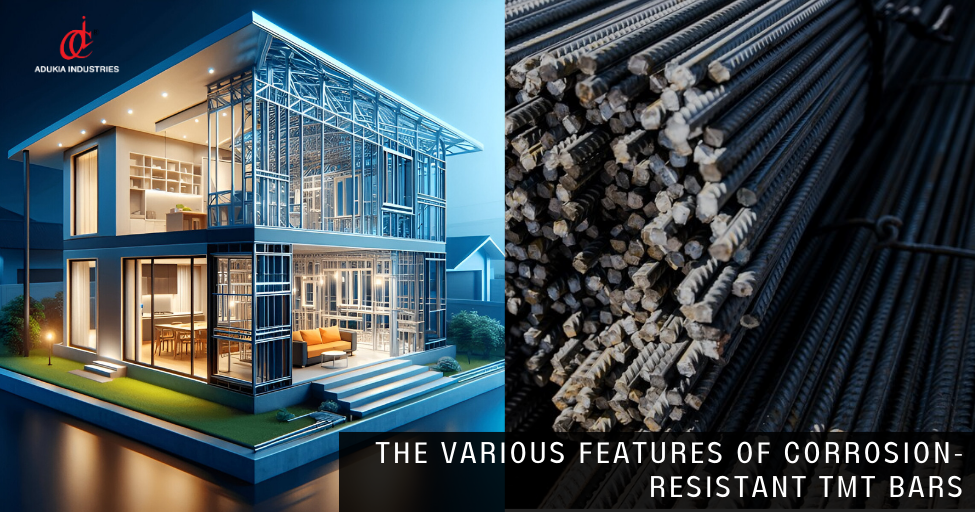
The Various Features of Corrosion-Resistant TMT Bars
Construction is a long-term investment with the strength of any construction being directly dependent on the quality of materials used. TMT bars are among the most critical materials in contemporary construction since they become the very backbone of buildings, bridges, and other infrastructures. Yet, natural elements like moisture, salt, and chemicals can turn into rust, gradually weakening the structure. The use of corrosion resistant TMT bars comes into play. These rust-proof TMT bars offer much more durability, giving designs an assurance of strength and safety for decades to come.
In this blog, we will discuss the corrosion-resistant features of the TMT bars, their advantages, and why they are regarded to be the best for coastal areas.
What is corrosion?
Corrosion is a natural phenomenon through which metals, such as steel, tend to react with the atmosphere, essentially by forming oxides or rust when moisture and oxygen are present, causing a deteriorating effect on metal’s structural integrity, and this very natural process becomes much more pronounced in humid, coastal, and industrialized regions.
What Are Corrosion resistant TMT bars?
TMT bars are specially treated and processed steel bars, subject to extreme heat treatments and cooling cycles, so as to improve strength, ductility, and protection from external elements. These anti-corrosive TMT bars are provided with a protective layer that hinders the process of oxidation and rusting, making them suitable for use in environments prone to humidity, salinity, or chemical exposure.
The inclusion of certain advanced materials with these bars such as copper, chromium, or phosphorus gives them high corrosion resistance, thus enhancing the durability of the structures they support.
How are corrosion proof TMT bars manufactured?
Advanced metallurgical techniques are involved in the production of corrosion-resistant TMT bars, enabling enhanced durability and rust proof. High-quality steel is heated to very high temperatures and swiftly cooled using a controlled water-quenched process. This would give it a tough exterior and soft inner core making it have great strength as well as bendability. Special alloying elements such as copper, chromium, and phosphorus are incorporated to enhance corrosion resistance.
Sometimes anti-corrosion surface treatment of TMT is done as an additional step. It may involve the application of epoxy coatings, galvanization and the like to prevent oxidation. These surface coverings act as a barrier to moisture and salt – perfect for construction in humid and coastal areas.
The last stage is the rigorous tests to make sure that the best TMT for coastal conditions is suitable according to the laid-down standards. These tests check for strength, ductility, and corrosion properties before certification for use. Such a rigorous process ensures demonstrated performance durability even in the most severe environmental conditions.
How corrosion occurs in steel reinforcement bars
Corrosion of steel bars embedded in concrete typically progresses through three main phases:
1. Incubation Phase
In the beginning, rust starts forming on the surface of the exposed steel rebar. This leads to tiny cracks around the junction where steel and concrete meet—this stage is known as the incubation period.
2. Initiation Phase
As corrosion continues, these cracks become more visible and start spreading. This is referred to as the initiation stage.
3. Propagation Phase
Over time, corrosion intensifies, producing more rust. This expansion increases pressure inside the concrete, leading to severe structural damage. Eventually, the concrete begins to break away from the rebar, a condition known as spalling.
Features of corrosion resistant TMT bars
TMT bars have several features that ensure that your construction remains strong and steady for years.
1. An Amalgamation of Alloys
Corrosion resistant TMT bars are not just iron and steel. Iron and steel will rust, as they oxidize, in the presence of oxygen in atmospheric air. Therefore, to make corrosion resistant TMT bars, some steel plants add chromium, nickel and some other materials in a specific ratio, which makes them resistant to corrosion.
2. Superior Endurance
TMT bars that are resistant to corrosion have a high resistance to adverse environmental conditions like groundwater salinity or acidic substances. On the contrary, ordinary TMT bars do not possess these properties and, hence, suffer corrosion owing to these conditions.
3. Consistency Matters!
TMT Bars are manufactured with a high degree of precision, maintaining uniformity among every bar. This uniformity is vital for structural stability, especially in buildings.
4. Smart Savings, Minimal Upkeep
Though the initial cost of corrosion-resistant TMT bars can be marginally more expensive than the ordinary steel bars, their long-term benefits are quite substantial. The need for maintenance and repairs is lowered significantly, making the initial investment definitely worthwhile. Structures constructed with corrosion-resistant bars do not require much maintenance at all; therefore, both time and resources are saved.
5. Ideal for Coastal and Humid Areas
The best TMT for coastal areas are those that can withstand high humidity and saltwater exposure without corroding. Hence, these corrosion-resistant TMT bars are specially manufactured for use in extreme weather conditions, ensuring that foundations remain strong over a long period.
6. Technologically Advanced Bars
With high-end and advanced technology, it is possible to manufacture corrosion resistant TMT bars. This implies that the industry is fully equipped with modern amenities to produce these TMT bars, thus making them technologically advanced from ordinary TMT bars.
How to test corrosion resistance?
Several tests need to be performed to ensure that the TMT bars are corrosion-resistant. Some of the commonly employed resistance-tests include:
1. Immersion Testing
This is a conventional test for corrosion in the lab. Herein, the weights of dried test specimens are weighed before and after having been exposed to a corrosive environment for a definite period of time. The subsequent procedure cleans away anything that causes corrosion.
2. Salt Spray / Fog Testing
This test is conducted to guarantee the durability of TMT bars in terms of corrosion resistance so as to simulate harsh coastal or industrial conditions. It makes sure that such reinforcement offers high resistance against rusting and long-term structural strength and reliability.
3. Atmosphere Exposure Test
This test, also known as weathering test, evaluates the durability of steel samples, looking into their relative ability to withstand the effects of UV light, heat, and cyclic changes in temperature.
Points to remember when choosing corrosion resistant TMT bars
Some important factors must be considered to ensure the quality and performance of corrosion-resistant TMT bars.
Trusted Manufacturer:
Choose a reliable and reputed corrosion resistant TMT bars manufacturer. A trusted manufacturer ensures the use of high-quality raw materials and advanced technology, which directly affects the strength and corrosion resistance of the TMT bars.
Quality Check:
Always conduct a detailed quality check focusing on strength, durability, and the manufacturing process. This evaluation should be done under expert supervision to ensure you’re choosing the best.
Certifications:
Check whether the TMT bars have necessary certifications like ISI, which ensures that the bars meet industry standards and guidelines.
Right Grade:
Make sure to choose the right grade of TMT bars as per your structural requirements. Grades like Fe 550 and Fe 550D are known for their corrosion-resistant properties and long-term durability in harsh environments.
Conclusion
Corrosion resistance is an important factor in choosing TMT bars for construction. These bars have many benefits over conventional TMT bars, especially for areas that face exposure to high salinity. The adoption of corrosion resistant TMT bars, such as those from Adukia Industries, has changed the way constructions are done by fighting the rust effect on steel structures: hence builders and engineers can easily design low-maintenance, long-lasting buildings. Thus, corrosion resistant TMT bars are no longer an option but a mandatory choice for construction!